One recording, any write-up: how lenses work
You recorded a ninety-minute client meeting. Your project manager wants the decisions. Your account lead wants a brief. You want the list of things you promised to do. Somebody wants the exact wording of what the client said about the budget.
That is four documents from one recording. Most tools give you one summary, in the shape the vendor picked, and if it does not fit your work you copy the text into a document and redo it by hand.
The four write-ups, in about a minute
Record the meeting once. yapyap transcribes it and labels who spoke. Then you choose a write-up and it produces one.
- Minutes. Topics in order, with what was agreed under each.
- Action list. Who committed to what, and by when if a date was said.
- Quote sheet. Passages worth quoting, each with a timestamp so you can play the audio and check.
- Client brief. The same meeting written for somebody who was not in it.
Each one reads the same transcript and asks a different question of it. You do not re-record, re-upload or re-listen. Change your mind about the shape and run a different one.
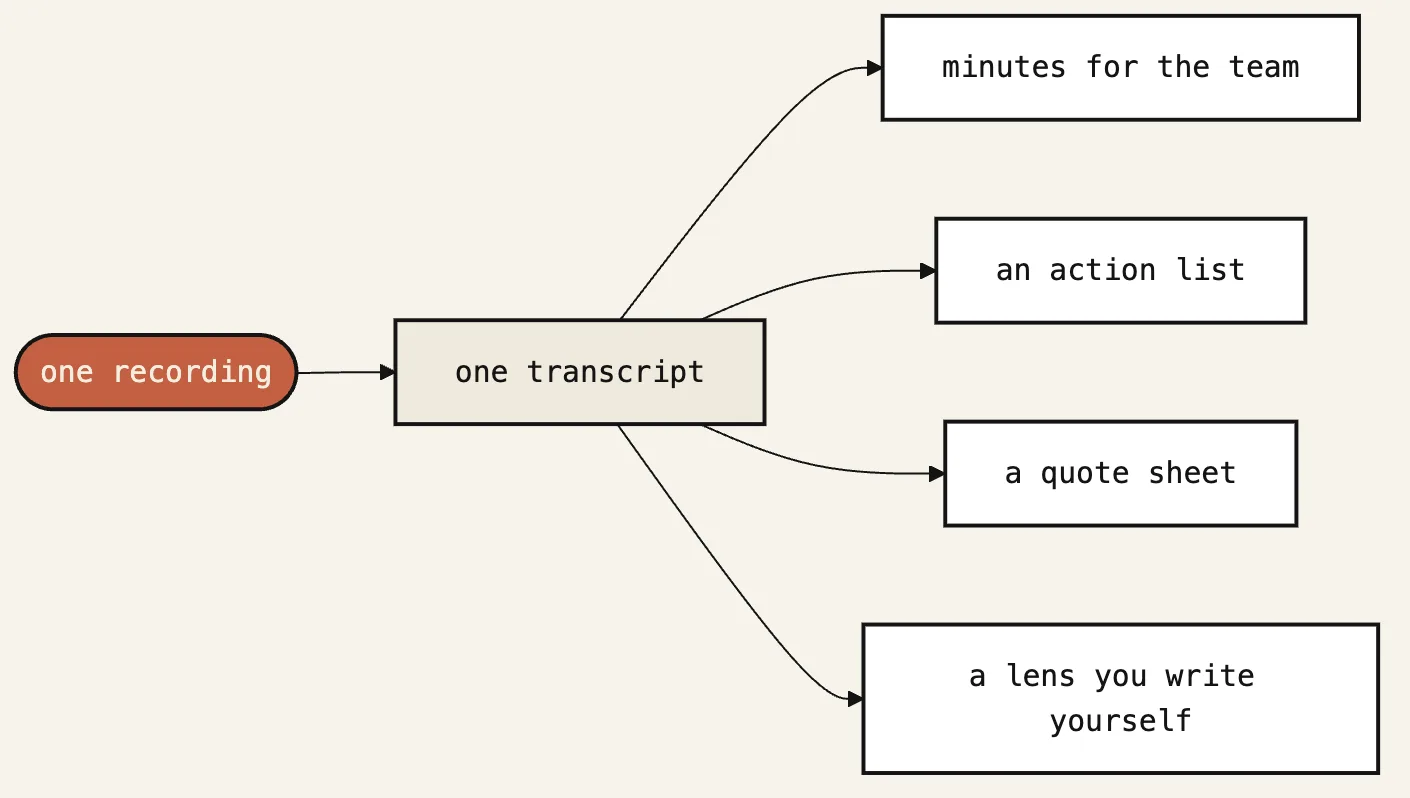
Where the write-ups come from
Each write-up is a lens: a name, a set of instructions, and a promise about what fields come out. That last part is what makes it reliable. A lens declares that it produces a list of decisions with an owner and a date, so you get that shape every time rather than a paragraph that happens to mention decisions.
Because a lens does not depend on your particular recording, it travels. Somebody who runs the same kind of meeting you do can write one and hand it over. Install it and it works on your recordings.
Lenses also stack. A rough-notes lens can feed a decisions lens, and installing the second pulls the first along with it.
Writing your own
If none of the shipped lenses fits how your team works, write one. You need a name, instructions in plain language, and the list of fields you want out. There is no code involved.
Publishing today means a pull request on the registry repository rather than a button in the app. That friction is on our list to remove, and we would rather say so than let you find out at the point of publishing.
What you should know before installing somebody else's
Installing a stranger's lens means running their instructions over your private conversations. Three things are worth knowing.
A lens cannot contain a program. It carries a description of an output shape, never executable code, and yapyap never runs fetched content as code. Every download is checked against a recorded fingerprint before it can install, and anything that fails is rejected with a reason.
Trust stops at the source you added. A lens from one registry cannot quietly pull in a dependency from somewhere you never subscribed to.
The instructions themselves are the author's. They run against your transcript on whichever model you configured. Point yapyap at a local model and nothing leaves your machine. Point it at a hosted provider and your transcript goes where you sent it.
The audio never travels either way. A lens moves as a few kilobytes of text, and your recording stays where it was made.
yapyap records, transcribes, and summarizes on the hardware you already own. No account, no subscription.
Free to try. No card, no account.
Then €69, once. Yours forever, every update included.
Your recordings never leave your computer.